Modern travel is no longer about finding empty spaces. It’s about learning how to move through crowds—airports, transit hubs, city centers—without friction. Few places illustrate this reality better than Japan, where some of the world’s most densely populated cities operate with remarkable efficiency.
Tokyo, Osaka, and Kyoto welcome millions of residents, commuters, and visitors every day. Streets are busy, stations are packed, and schedules are precise. In this environment, staying connected isn’t a convenience—it’s a tool for navigating density.


Density Without Chaos: Japan’s Urban Paradox
At first glance, Japan’s major cities can feel overwhelming. Train platforms fill in seconds, crossings pulse with synchronized movement, and public spaces rarely feel empty. Yet despite this density, chaos is rare.
That’s because movement is highly structured. Timetables are accurate to the minute. Pedestrian flows are intuitive. Digital signage and announcements guide people continuously. The system works—but only if you can access it in real time.
For travelers unfamiliar with the language or the rhythm of these cities, connectivity becomes the bridge between confusion and flow.
Why Connectivity Matters More When Everything Is Crowded
In low-density environments, small mistakes are forgiving. Miss a turn, and you can backtrack. In dense cities, those same mistakes cost time, energy, and patience.
Mobile connectivity helps travelers:
- check live transit updates during peak hours,
- reroute instantly when platforms or lines are congested,
- coordinate meeting points in busy districts,
- avoid bottlenecks during events or rush hour,
- translate signs or announcements on the spot.

When thousands of people are moving at once, real-time information is what allows individuals to move efficiently within the crowd rather than against it.
Japan’s Cities Run On Digital Layers
Much of Japan’s urban efficiency depends on invisible digital systems. QR-based tickets, app-based reservations, mobile navigation, and live alerts are woven into everyday movement. Even short trips often rely on multiple data points: which exit to use, which car to board, which line is delayed by two minutes.
For visitors, accessing these layers requires constant mobile data. Wi-Fi can help in controlled spaces, but movement through a city is continuous. Disconnection creates friction at exactly the moments when clarity matters most.
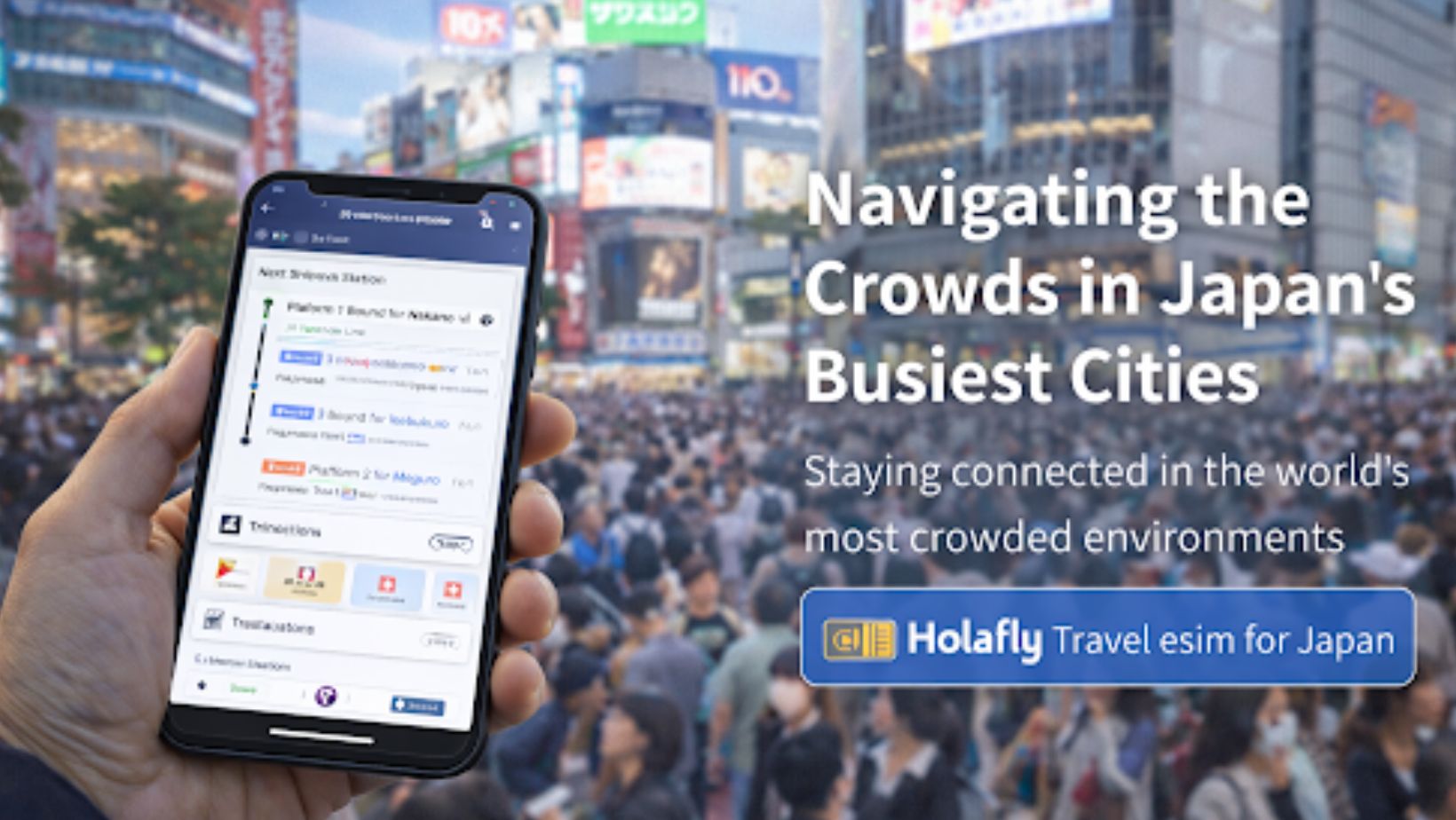
For travelers navigating Japan’s busiest cities, tools like the Holafly travel esim for Japan make it easier to stay connected in real time, even while moving through some of the most crowded urban environments in the world.
Crowds Change Behavior—And Technology Mediates It
Crowds influence how people think and move. Uncertainty spreads quickly in dense environments: a missed train, an unclear sign, a delayed message. Connectivity reduces that uncertainty.
With access to live maps, schedules, and translation tools, travelers make faster decisions. They pause less. They hesitate less. Over time, this individual clarity contributes to smoother collective movement.
Technology doesn’t eliminate crowds—but it helps people flow within them, rather than disrupt them.
Safety, Coordination, And Mental Load
Beyond efficiency, connectivity also affects how safe and calm crowded travel feels. Being able to share locations, send quick updates, or look up alternatives reduces mental load. Instead of constantly scanning for information, travelers can rely on their devices to fill the gaps.
In cities where millions move together, that reduction in cognitive strain matters. It turns density from something stressful into something manageable—even impressive.
Moving Smarter Through Dense Cities
Japan offers a preview of what urban travel increasingly looks like worldwide: dense, fast, and highly coordinated. In that context, the challenge isn’t avoiding crowds—it’s learning how to move through them intelligently.
Connectivity is no longer just about access. It’s about participation in the system that makes dense cities work. When travelers stay connected, they don’t just survive the crowd—they become part of its rhythm.